


The signal scanning, cross-industry thinking, and futures-oriented mindset that powers Strategy Stories happens in the margins of books, in the hours between client engagements, and in the belief that the best strategic insights come from unexpected places.
I’m trending ahead on my annual reading goal, and wanted to share an early year in review list with my best books of 2026, so far. Not every book on this list is a strategy text — some are pure escapism, some are ancient epics, some are fantasy and sci fi novels — but all of them shaped my thinking in 2026.
The Classics
Christopher Nolan’s star-studded rendition of The Odyssey became the highest grossing R-rated movie of all time as of August 2026. At a time when technology has never evolved faster and political events yield unprecedented times, the monolith of cultural discourse in summer 2026 was a movie based on a battle entrenched in historical context and poetic myth that allegedly took place around the twelfth century BC and one leader’s very long journey home. With thousands of years of stories spoken and written since then, this plot still managed to dominate the global box office.
Naturally, I had to start the year with a reread of The Iliad and The Odyssey to ensure full preparation for the movie which then brought me to reading The Aeneid for the first time.* Three things stuck out to me. First, The Iliad is less of a story about a battle and more of a cautionary tale about what happens when leaders don’t model good leadership, and the impact of ego and hubris on group efficacy. Second, Odysseus isn’t really the best role model in The Odyssey, and I’d even go so far as to say he’s unlikable. I didn’t mind the creative license Nolan took with reshaping this character arc in the film, regardless of the concerns raised by scholars. Lastly, the fall of Troy doesn’t actually happen in The Iliad or The Odyssey, and The Aeneid is a must-read for filling in the gaps.
Strategic Foresight Disguised as Sci Fi
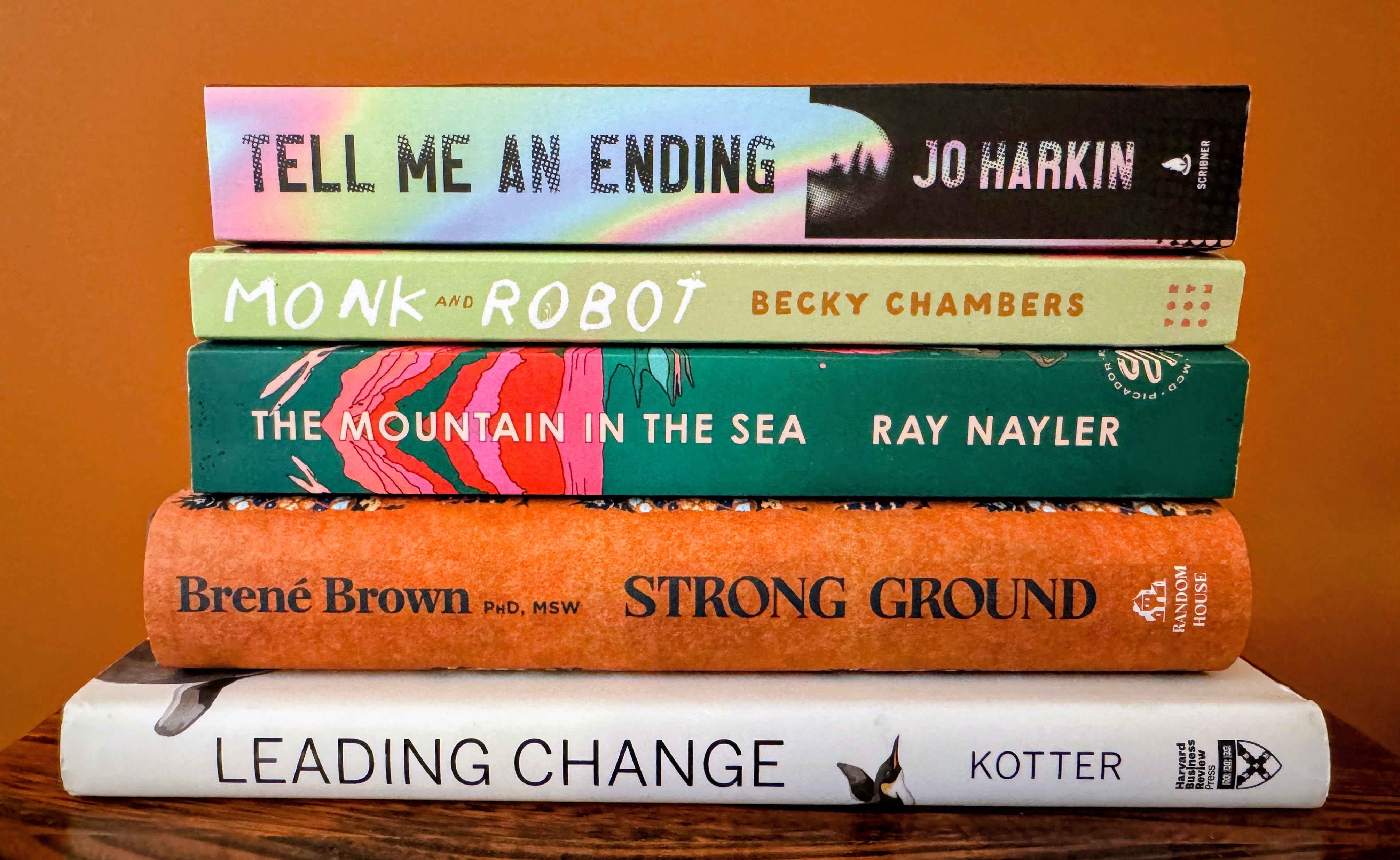
I’ve shared thoughts on the role of “preferred futures” in previous Strategy Stories content and identified Monk and Robot as a duology that gave me new appreciation for preferred futures and that gave me hope for what a world could look like that is focused on holistic environmental sustainability and social harmony and inclusion. A probable future? Perhaps not. But, I firmly believe that we can’t move in a new direction without crafting a vision of what that future state could look like.
When I finished The Mountain in the Sea, I described it as the kind of novel Michael Crichton would write if he was still alive. Crichton heavily influenced my early reading lists and left me awestruck with his ability to take a current political event or emerging technology signal and transform it into a realistic, yet unfathomable story that provoked realistic reactions on what this scenario would yield. Ray Nayler delivers a similar model of storytelling, and prompts you to rethink the meaning of intelligence and consciousness…and what would be true if these are not exclusively human attributes.
Tell Me an Ending asks an uncomfortable question. If you could select a specific memory to erase from your own mind forever, would you? And if you did, would you want to know that you made that choice afterwards? Through a complex web of intertwined characters navigating different stages of memory loss and gain, Jo Harkin confronts the uncomfortable questions and reshapes the perception of identity.
Managing Disability, Loss, and Addiction
Sometimes a fictional narrative about navigating limitations and obstacles is the best case study for considering what adaptive strategy feels like in practice.
I’ve been reading Jim Butcher’s wizard-detective Dresden Files saga for more than a decade, and his latest installment, Twelve Months, did not disappoint. What impressed me most, other than the fact that Butcher continues to deliver on schedule with his publisher, is how artfully he told the story of his protagonist, Harry Dresden, navigating loss and what’s next. Butcher makes you feel like you’ve finally been able to reconnect with an old friend, and are there at the moment you’re most needed.
I reread Joe Abercrombie’s First Law trilogy before reading a standalone book, Best Served Cold, set in the same universe earlier this year. Abercrombie writes exclusively in the fantasy genre, but his ability to tell the story of his characters navigating disability and addiction is unprecedented, and shows a strong understanding of physiology, psychology, and accessibility. There’s no other author that will encourage you to root for an anti-hero character who is their nation’s chief torturer, nor one that manages to incorporate the stages of addiction recovery into a fantasy protagonist’s character arc with such care and compassion.
This recommendation is premature, but I’m most excited for Rebecca Yarros’s Threshing Day release later this month. I started reading The Empyrean series while I was in the process of getting diagnosed with celiac disease (a chronic autoimmune disorder) and severe anemia (a treatable side effect of celiac). I spent those early weeks feeling utterly incapable on a physical level, unable to absorb iron without the assistance of a multi-hour intravenous infusion and unable to eat the “normal” foods everyone in my immediate environment could safely consume. Yarros’s protagonist, Violet Sorrengail, suffers from Ehlers-Danlos syndrome which brings physical challenges to her ability to navigate the strict physical requirements and tests of the war college she attends. I took inspiration from Violet’s focus on building physical strength, finding alternative pathways, and – most critically – preparing to take on the next challenge.
The Business Shelf
I’ve previously shared my affinity for Mel Robbins’s Let Them, but will reiterate here – the thesis is so simple that it’s disarming. Try it out. Let them!
I did a few consulting engagements focused on change management this year and reread John Kotter’s Leading Change as part of my preparation. When I first read Kotter, I focused on the action…how do we get the change done, measured, and proven! What stands out to me the most now, especially working on various strategic initiatives with partners this year, is that the importance of awareness of the need to change – and buy-in on that change – is the showstopper. If you’re not there yet organizationally, focus on that step until you see a meaningful level of readiness.
I actually read Brené Brown’s Strong Ground in late December 2025, but I just couldn’t omit this one from the 2026 list because I didn’t talk about it enough during the holiday season last year. What I loved about this book was her opening thesis about using weightlifting and strength training to build a stronger core to get back to playing pickleball with full mobility. Strong Ground brings a consistent reminder that fortifying and building strength doesn’t come at the peripheral, but is foundational to all other progress.
Cancel Tomorrow’s Plans Before Starting
Lastly, I read three books that were just so good that I’d recommend canceling your plans for the weekend preemptively.
Parasite: A nonstop sci fi thriller by Darcy Coates about an alien invasion that I just can’t stop thinking about. It’s like Animorphs for adults.
The Stand: I started this in 2020 and had to abandon it due to the parallels with the early stages of the Covid-19 pandemic. Enough time has passed…and I’m so glad I picked this page-turning, post-apocalyptic story back up. In my experience, only Stephen King and Brandon Sanderson have the ability to make a 1,000+ page book feel so short.
The Night Agent: There’s nothing supernatural here, but I can assure you that I felt secondhand fatigue from trying to keep up with FBI agent Peter Sutherland through this nonstop political thriller. Netflix’s television show adaptation is great, but Matthew Quirk’s original narrative is truly next level.
In Closing
Most of the books on this list won’t be found in the business section of the bookstore. Strategy Stories is driven by signal scanning, cross-industry insights, and futures thinking, and the most powerful scenario planning and foresight breakthroughs begin with imagining the unimaginable. From ancient epics to dystopian futures and from underdogs to anti-heroes, there’s power to be found in stepping outside of the known environment and imagining something new.
Thanks for reading Strategy Stories by Lavorgna Strategy Studio!
About Strategy Stories
Strategy Stories is built on a single belief: the most useful strategic insights don’t always come from inside your industry. Through this platform, Jackie Lavorgna, PhD, SMP shares case studies, analyses, and anecdotes for curious leaders, strategists, innovators, and futurists — spanning readers throughout the United States and across 16+ countries.
Strategy Stories is the insights vertical of Lavorgna Strategy Studio, a consultancy helping leaders, teams, and organizations prepare and plan for the future through strategic planning and strategic foresight.
*Note: This post includes affiliate links for book recommendations. If you make a purchase through one of the affiliate links, I make a commission at no charge to you.
Jackie, I’m sorry to learn about your diagnosis yet I love how you’ve carefully described your recent reads for us. I’ve been wanting to get back to reading fiction and maybe I will give The Stand a read! Here’s to finding strategy in the margins.