


I was 10 years old the first time a book truly shocked me. Most books written for kids and tweens have tidy endings – things get wrapped up, loose ends are tied or swept under the rug, and generally the characters end up happy. The final book of K.A. Applegate’s science fiction series, Animorphs, took all of those norms and flipped them on their heads with a plot twist that 10-year-old Jackie just didn’t see coming.
I was devastated.
Complete shock.
But also, I loved it.
I mulled over the outcome in my head for weeks, trying to determine how Applegate could have landed on this ending. Did she have to get permission from the publisher for such an end? Should I have seen this twist coming? Was there even foreshadowing for the ending? I was flummoxed.
Animorphs came up in a recent conversation I had about book recommendations for late elementary/early middle school readers. I recommended the sci fi series as one of my all time favorite books from that age, packed with strong worldbuilding, relatable young protagonists, and an action-packed alien invasion setting. What I’ve come to realize is that this book represented a critical turning point for me in my reading journey as I came to discover that authors could play with seismic shifts and environmental impacts spanning ecological, technological, and political advancements in the same way that the real world did – and that the ending was, similarly, not actually tidy. The conclusion of the science fiction series represented an “undesirable future” scenario in my opinion given the convergence of trends, events, and plot twists...but one that Applegate had the agency to select and bring forward. The unfathomable was logically consistent in her science fiction setting, even if undesirable.
Strategic foresight practitioners use a framework called the Futures Cone to map the range of possible futures from the most preposterous to the most preferred. From early iterations from researchers in the 1970s at the Hawaii Research Center for Futures Studies to Theunissen’s more recent take on the Futures Cone, the framework considers different versions of the past, cultural histories, and mythologies. These elements intersect at multiple perspectives on the present and culminate in an offering of multiple possible futures, including preposterous, plausible, preferred, probable, possible, and undesirable futures.
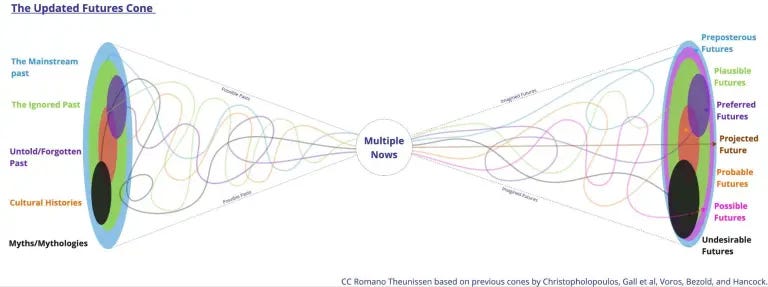
Speculative fiction has been exploring this territory for decades. Applying the Futures Cone to speculative fiction doesn't require the scenarios to be literally possible — the value lies in inhabiting fictional scenarios and building the cognitive and emotional capacity to navigate real disruption when that disruption arrives in its own unexpected forms.
If undesirable futures are so unsettling, even in fiction, why seek them out at all? Neurological research offers a compelling answer. Deep immersion in a fictional narrative can catalyze a phenomenon known as narrative transportation which enables the reader to leverage new mindsets or traits through activation of mirror neurons, according to Dubai Future Foundation. As a result, living an undesirable scenario in real life can unearth muscle memory from reading fictional accounts, enabling the reader to leverage those learned instincts from narrative transportation. Modern psychology also tells us that envisioning worst-case scenarios can actually help you prepare for a broader range of possibilities, including developing an action plan for how to tackle the worst if it does come to pass. While Animorphs represents an both undesirable and implausible scenario, there’s clear benefit in resilience and readiness from reading, analyzing, and reflecting on speculative fiction that results in an undesirable future at the end.
The preferred future — another zone within the Futures Cone — gets its turn in Becky Chambers’s Monk and Robot duology, which I finally read earlier this year. I completely missed the first book, A Psalm for the Wild-Built, when it came out in 2022 (a year that I moved, started a new job, began my dissertation, and was wading through the Wheel of Time series). Needless to say, I still couldn’t believe that I had missed a Hugo Award-winning book about a tea expert who becomes friends with a robot while out in the woods. This was truly an iconic premise.
A Psalm for the Wild-Built ended up being one of those books that I read slowly because I kept putting it down to text friends and colleagues, unprompted, and tell them about how captivating this book was. I simply had to spread the word for others who might have been distracted in 2022. The reason for this was simple, and tied right back to the Futures Cone.
Envisioning a world in which robots, responsible for leading production at large for human civilization, gained self-awareness and parted from human society, leaving humans to transform their ways of living or perish, Chambers told a deeply relatable, empathetic story through the framework of a plausible and preferred future scenario. Through Chambers’s story arc for the titular characters, the monk and the robot, the reader understands the technological, societal, and ecological conditions that prompted a need for change and transformation. The reader is then introduced to a nearly unrecognizable human society that includes a range of new urban and rural structures, societal norms, and economic rules. At times, the story sits just at the edge of plausible even in a science fiction setting, but undoubtedly, a preferable future when compared to the risk of devastation hinted at throughout the book if humanity had stayed the course towards self-destruction.
I found myself wondering – does the framing of this narrative as a “best case scenario” following the threat of destruction still make this a worthy, intellectually stimulating read? Was I losing something by not reading a novel that refused to tidy up loose ends or take care of characters in the wake of unexpected danger? As I’ve previously shared on Strategy Stories, I’ve struggled at different points in my life to justify preferring speculative fiction over nonfiction, and at times this level of fantastical imagination seemed to go just a little too far.
But then I realized something critical.
Chambers’s novels made me feel hopeful about the future.
I didn’t feel confident that this was the direction humanity is headed towards…but I found myself taking reassurance that if Chambers could envision this possibility, there was also a scenario in the real world in which the right factors come together to address looming societal challenges (perhaps excluding a robot uprising though).
This is the magic of preferred futures, which is also anchored in psychology and neuroscience research. The preferred future is a consistent inclusion for both Theunissen’s more recent take on the Futures Cone as well as the early iterations of the framework. While the preferred future may feel like an overly Pollyanna-take on possible futures, there is a clear benefit in imagining preferred futures in order to increase the likelihood of making that future possible. Simulations of the future help to build muscle memory, situation evaluation, and refinement of decision making. Discussing the distant future activates different parts of the brain than the near future and envisioning episodic futures at present prompts actual behavior change to move towards desired futures (or away from unpreferred futures).
It’s hard to think of two series more dissimilar than Applegate’s Animorphs and Chambers’s Monk and Robot, but I love thinking of them as two distinct literary points on the possible futures continuum when considering the Futures Cone framework….and two series that offer different lessons for foresight, resilience, and growth.
Animorphs encourages you to cheer for a group of underdogs, kids who are trying to stop an alien invasion without the help of their parental figures. The ending isn’t what you’d expect, but the leadership lessons and growth the characters experience along the way provide a great set of characteristics to take inspiration from.
Monk and Robot invites you into a world where the challenges of today’s society have largely been addressed and the new adventures that take place in a technologically, ecologically, and socially advanced human civilization provoke unprecedented imagination. The premise may not feel close at hand, but leaves you wondering what action you could take today to bring the world a step closer to this future state.
Thanks for reading Strategy Stories by Lavorgna Strategy Studio!
About Strategy Stories
Strategy Stories is built on a single belief: the most useful strategic insights don’t always come from inside your industry. Through this platform, Jackie Lavorgna, PhD, SMP shares case studies, analyses, and anecdotes for curious leaders, strategists, innovators, and futurists — spanning readers throughout the United States and across 16+ countries.
Strategy Stories is the insights vertical of Lavorgna Strategy Studio, a consultancy helping leaders, teams, and organizations prepare and plan for the future through strategic planning and strategic foresight.