


What do you do with a short block of free time in Irving, Texas?
My travels recently brought me to this city — my first time in the Dallas/Fort Worth area outside of the airport. I had just a bit of free time to work with and was determined to make the most of the block.
Scanning for an activity, I perused the usual suspects. A lovely looking park. An aquarium. A concert venue (who’s playing?). Lyft drivers suggested local alternatives such as the daily running of the cattle in the Stockyard and a visit to a 100-year-old steakhouse. I had inadvertently neglected to mention my 20+ years as a vegetarian.
What caught my eye though, was a herd of mustangs…immortalized as statues in a city square.
Some fast facts on mustangs: While the American mustang is a recognizable symbol of the American West, and further bolstered by the Ford Mustang, mustangs are actually not native to the US. They are horses that descended from horses brought to the Americas by early Spanish explorers. As some of the horses made their way to freedom, free-ranging populations of mustangs emerged and crafted the iconic image of wild mustangs we think of today.
Naturally, this set of statues depicting a herd of wild mustangs in the middle of an urban area quickly rose to the top of my list.
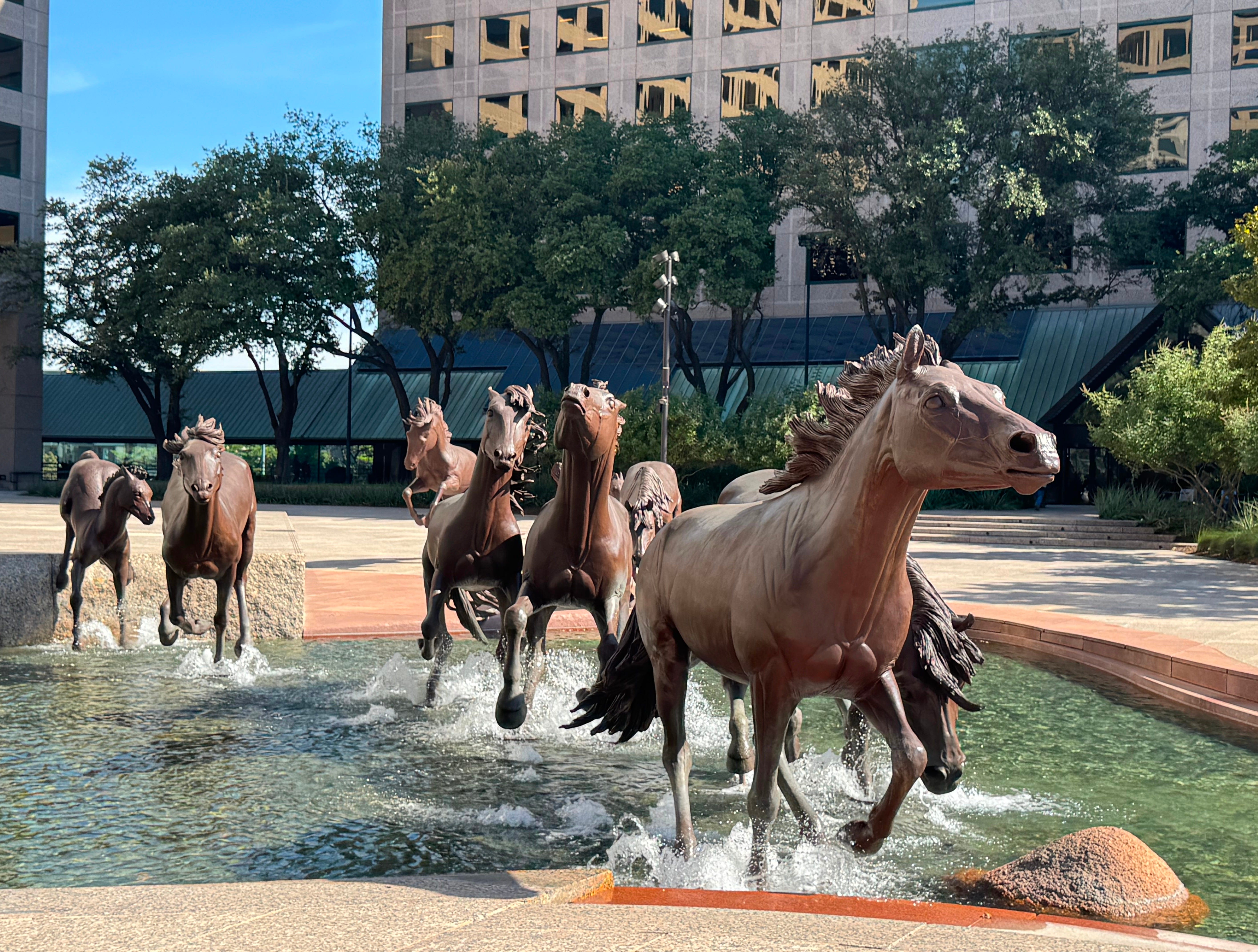
As I approached the statues, called the Mustangs of Las Colinas, I noted that the herd was centered in the square with ample breathing room in the form of green space and walking areas around them. The surrounding buildings felt like an afterthought. Coming closer, I was struck by how the horses seemed to be moving — especially from my peripheral vision. After taking in the herd from a few different views, I went to the museum at the visitor center.
I met Mary, the museum tour guide, who shared her deep knowledge of the sculptures, the story of the artist and his works, and the Las Colinas area. Created by sculptor Robert Glen, the mustangs first emerged as a larger herd of miniature prototypes. Glen shared the set with the commissioner, Ben H. Carpenter – a developer seeking to evolve his family ranch into a new development (“Las Colinas”) – and narrowed down the herd to the nine mustangs depicted today. From the miniatures, intermediate-sized maquettes were then created in Glen’s workspace in Nairobi, Kenya, and shipped to Basingstoke, England, where one of the only foundries in the world that could handle a bronze sculpture of this size was located.
Glen’s iterative approach highlights the role of prototyping. Design thinking tells us that starting with a prototype unlocks the ability to play, test, and iterate before reaching the final version. This gives the opportunity to get to the vision in shorter bursts, while bringing in sponsor feedback along the way.
What can you prototype, before locking in on the final?
Notably, Glen used no photos of mustangs in his design and sculpting process, relying on memory and an understanding of the essence of the animal and its movement. As I mentioned earlier, the herd seemed to be actively on the move from every angle. Somehow, without using a still frame to capture the movement and reproduce it perfectly, Glen created a visual that embodies the art of activity without ever slowing down to compare his output to a captured reference point.
Generative artificial intelligence increasingly pulls from what already exists, copying and duplicating en masse. Glen’s approach focuses on imagination and inherent understanding of the subject, over photo-accurate specifications.
What detail might we lose when copying a picture, versus imagining?
The museum showed pictures of the transportation process for flying the mustangs from London to Fort Worth and then driving them in large trucks to Irving for arrival at their new home.
What’s remarkable though, is that the sculptures were the first puzzle piece. The planning for the sculptures came first — the design of the surrounding buildings came afterwards. Carpenter’s vision was that the herd would be the focal point for development, giving them the space to breathe and encouraging industry to grow around them.
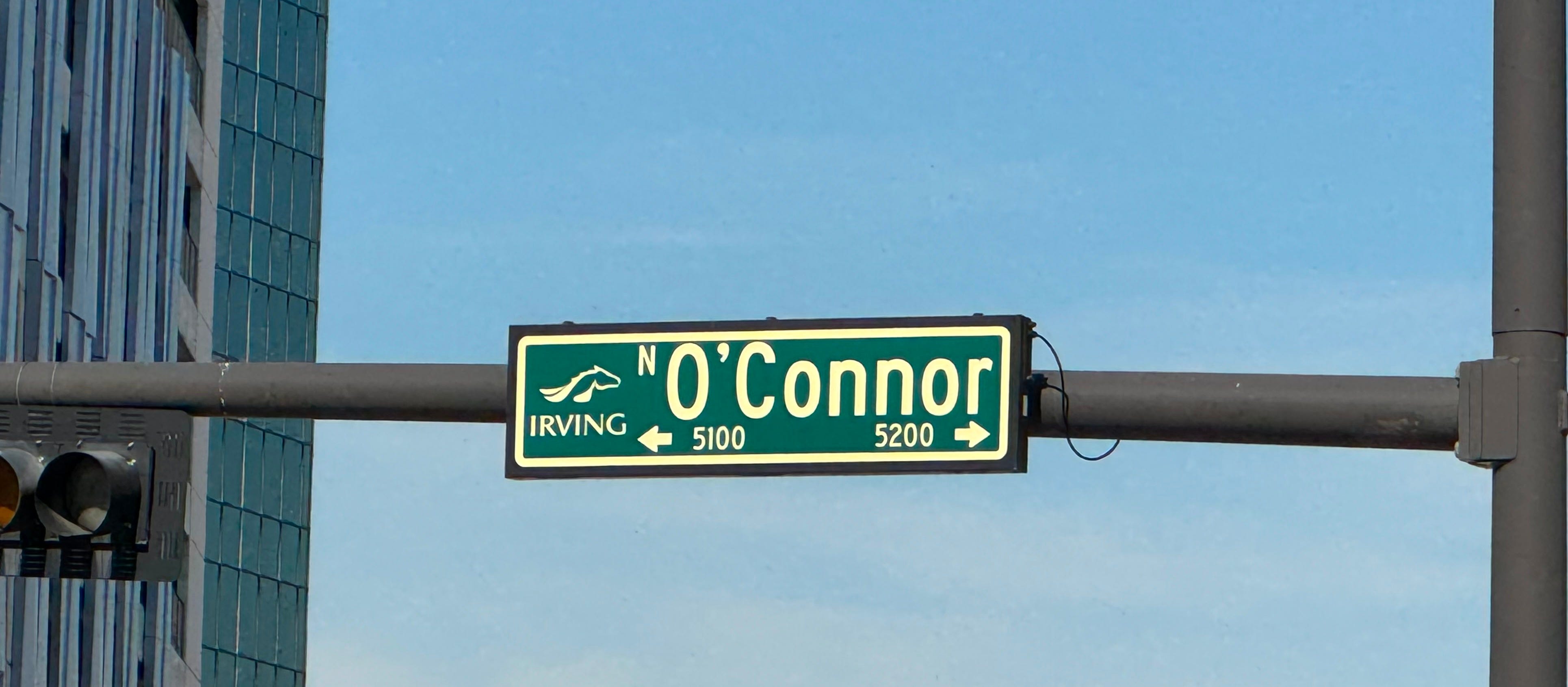
As a result, there’s ample room to walk and enjoy the sculptures in the immediate vicinity. The nearby office buildings have glass fronts on the first floor, enabling a clear view as well. Even the restaurant across the street boasts a strong viewing angle of the herd from the barstools. The herd has taken on a key role in the area’s cultural and visual identity, even being featured on street signs.
We often think of art as the last piece. The finishing touches. Once the room is painted and the furniture arranged, we wonder how to fill that open space.
We rarely start with the art piece.
Glen and Carpenter followed an unexpected order of operations, designing urban spaces for art instead of art for urban spaces.
What order of operations sequence have you accepted as an established norm, but that could be rearranged to create something new?
While this wasn’t my first guess at how I’d spend my free morning, I left with my curiosity satisfied and new questions about my own assumptions about order of operations – and what it looks like when art becomes a priority instead of an afterthought.
Thanks for reading Strategy Stories by Lavorgna Strategy Studio!
About Strategy Stories
Strategy Stories is built on a single belief: the most useful strategic insights don’t always come from inside your industry. Through this platform, Jackie Lavorgna, PhD, SMP shares case studies, analyses, and anecdotes for curious leaders, strategists, innovators, and futurists — spanning readers throughout the United States and across 16+ countries.
Strategy Stories is the insights vertical of Lavorgna Strategy Studio, a consultancy helping leaders, teams, and organizations prepare and plan for the future through strategic planning and strategic foresight.
This is fascinating, Jackie. In August, I went to an exhibition called "The Ark" at Powerhouse Arts in Brooklyn. The animals were all from different artists and in different mediums but even when somewhat abstract, their presence felt so true to the actual animal. I spent the longest time exploring each. You can take a peek here: https://powerhousearts.org/ark